How Boom Plans to Make Supersonic Travel the New Business Class

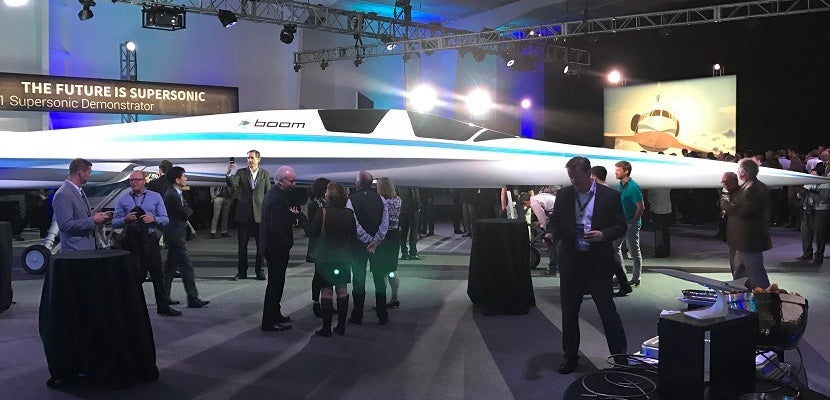
Since the retirement of the Concorde in 2003, airline passengers have had to settle for trips at well below the speed of sound. And while companies are hoping to build supersonic business jets, progress on supersonic commercial passenger aircraft has been a bit slower. Boom Technology is hoping to change that, however. Last night, the company unveiled a mockup of its XB-1 supersonic demonstrator at Denver's Centennial Airport. By 2023, it plans to deliver a passenger jet that travels at about 2.2 times the speed of sound — 10% faster than the Concorde and 2.6 times faster than other airliners.
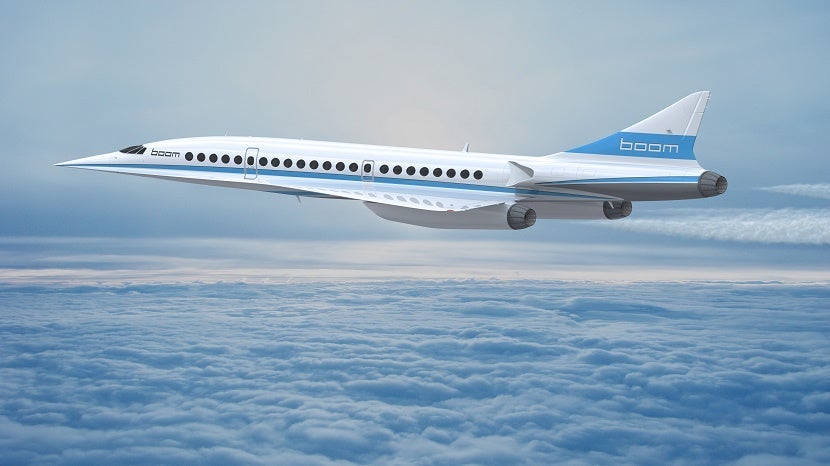
About the XB-1
The event at Boom's hangar featured a wooden mockup of the XB-1, which employs the same concepts the company will use in its airliner. The test article is already under construction, and the company plans to roll it out next year. According to Boom's Chief Engineer Joe Wilding, the primary goal is not to demonstrate supersonic flight itself, but to prove that the team can design and build a civilian supersonic aircraft with many of the same technologies it hopes to use for the full-scale passenger airliner.
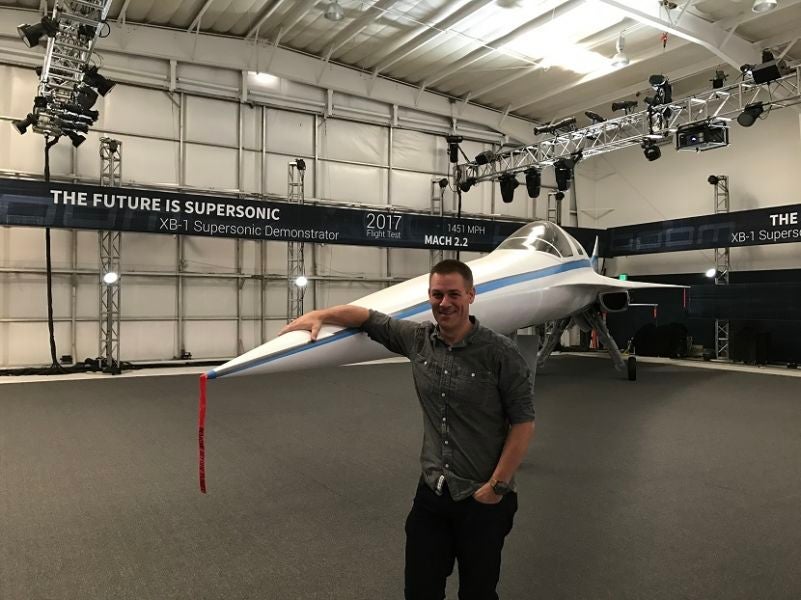
The XB-1 demonstrator will be used for subsonic flight tests in the Denver area, followed by supersonic tests near Edwards Air Force Base in Southern California. In fact, this is where Chuck Yeager first broke the sound barrier in the Bell XS-1 on October 14, 1947.
Boom Technology's testing will be done in conjunction with The Spaceship Company, which is Virgin Galactic's manufacturing subsidiary. With a cruising speed of Mach 2.2, the XB-1 will be the fastest civilian aircraft ever flown.
The Boom Technology Plan
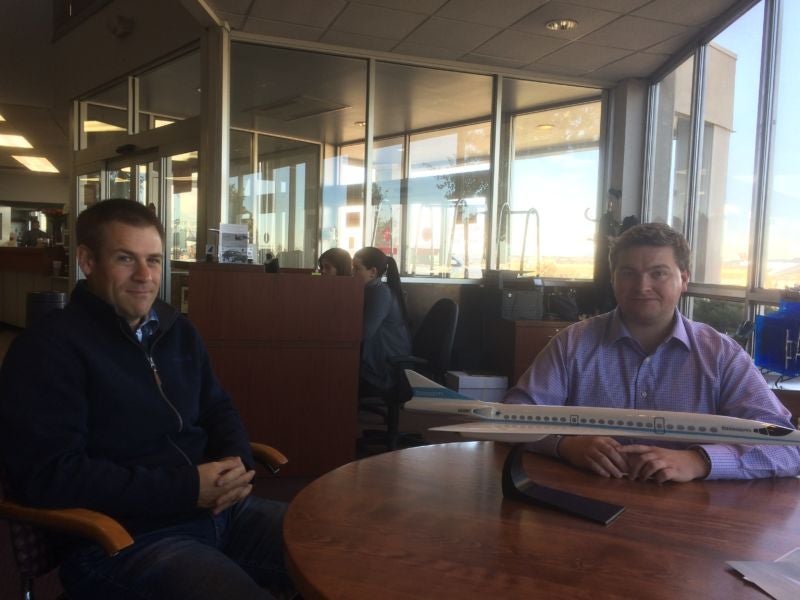
I had a chance to sit down with Boom's CEO Blake Scholl and Chief Engineer Joe Wilding, who explained their plan to bring back scheduled supersonic passenger flights. Scholl founded Boom in 2014 after becoming frustrated with the lack of progress in airliner development. His theory is that the Concorde didn't fail because of technical problems or the inherent costs of traveling beyond the speed of sound, rather because it was an economic failure partially due to the airlines' inability to fill nearly 100 seats with passengers paying prices well beyond business class (which Scholl calculates to be $20,000 in today's dollars).
Boom's taking a different approach; it hopes to build a supersonic aircraft that seats just 45 people, about the same capacity of a business-class cabin on a typical transatlantic wide-body. Better yet, Scholl hopes that carriers will be able to sell these seats for about the same price of today's business-class transatlantic fares, which they target at about $5,000 round-trip. The team's designing a three-engine aircraft with a similar cost per mile as a Boeing 737 or an Airbus A319 over a 4,000-mile flight.
Aside from a much speedier journey, passengers should expect an experience similar to what they'd find with current domestic first-class cabins, which should be sufficient for a transatlantic flight of less than four hours. Boom envisions about 22 rows with two seats in each, separated by the aisle.

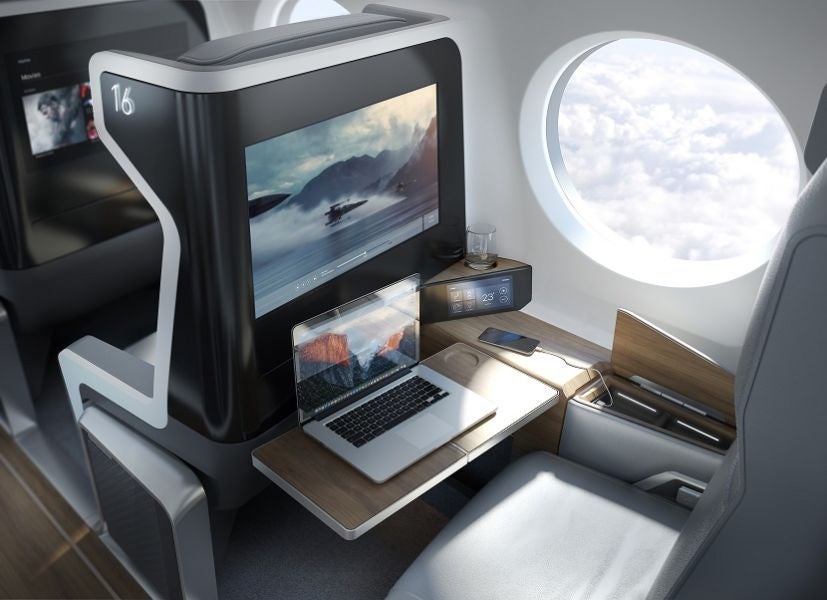
In addition, Boom's counting on the last 50 years of technological improvements to help create an aircraft that's at least 30% more efficient than Concorde. This may even be conservative considering the massive gains in efficiency that subsonic aircraft have seen since Boeing 707s and the McDonnell Douglas DC-8s navigated the skies.
Whereas British and French engineers used blueprints and slide rules to design the aluminum Concorde in the 1960s, Boom is leveraging computer-aided design to build its supersonic airliner out of carbon fiber. It's also working on a proprietary system to allow each passenger to have a large window, rather than the tiny ones seen on the Concorde.
How quiet will it be?
Another major limitation of the Concorde was that it couldn't fly supersonic over land, which meant it was largely relegated to overseas routes. The more recent crop of proposed civilian supersonic aircraft includes models that have hinged upon the idea that an aircraft's supersonic boom could be shaped or mitigated to allow overland flights.
While Scholl and his team aren't relying on overturning the regulatory ban on supersonic overland flight, the XB-1 should be much quieter than the thunderous Concorde was during takeoff — and even subsonic flights over land. This is thanks to modern turbofan jet engines, instead of the Concorde's loud turbojets which haven't been used by airliners in decades. The Concorde also used noisy and extremely inefficient afterburners for takeoff and to achieve supersonic flight, which Boom's aircraft doesn't need.
Does Boom have a chance?
Scholl, who is celebrating his 36th birthday this week, is a private pilot with with a history of creating technology firms in addition to working for major brands including Amazon and Groupon. It might seem unlikely for him to lead a small team of engineers in designing a class of aircraft that Airbus, Boeing and others have apparently given up on. However, the longer I spoke with Scholl and Wilding, the more I became convinced that they have a shot.
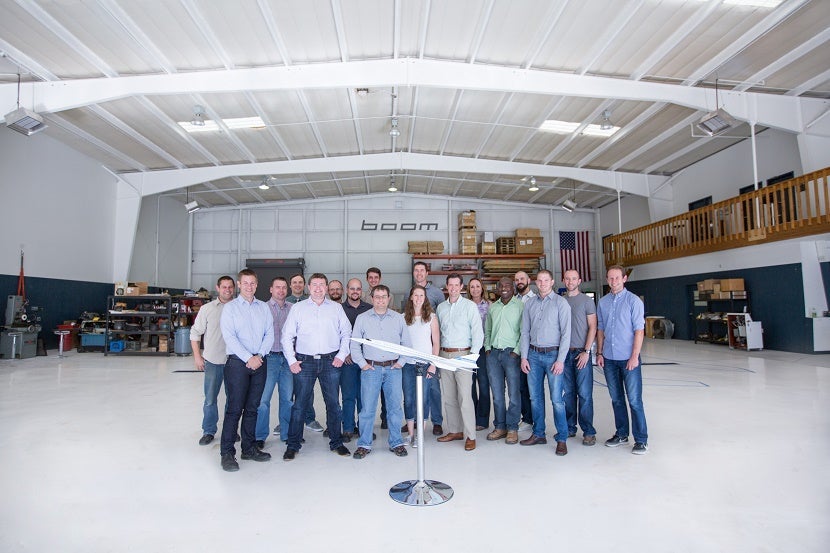
The two have assembled a team of 20 aerospace engineers who have experience leading similar design teams at renowned aerospace organizations such as Scaled Composites, SpaceX and Virgin Galactic. Like these companies, Boom is using a small team that works closely to quickly tackle technical problems one at a time.
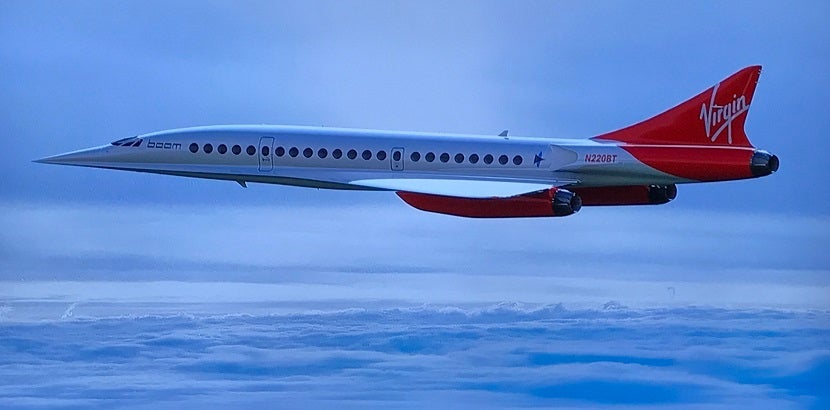
One prominent early backer is Richard Branson, whom I had a chance to interview earlier this year. In a press release, Branson said, "We're excited to have an option on Boom's first 10 airframes. Through Virgin Galactic's manufacturing arm, The Spaceship Company, we will provide engineering and manufacturing services, along with flight test support and operations as part of our shared ambitions." Boom has also received an order from an undisclosed European carrier.
While that's a good sign, even the Concorde received non-binding options for 74 aircraft from 16 carriers, but only delivered a total of 14 between Air France and British Airways. And needless to say, the track record for startup aircraft manufacturers is spotty at best.
What will this mean for award travelers?
Before the Concorde was retired, you could redeem 125,000 British Airways Executive Club miles or US Airways miles for a one-way ticket on the Concorde between New York and London. Delta charged 160,000 SkyMiles for a one-way Concorde ticket on Air France between New York and Paris. Travelers could also redeem 100,000 Starpoints for 250,000 Qantas miles, enough for a round-trip ticket on the aircraft. Bear in mind that a seat on the Concorde cost roughly $10,000 at the time, about the same as an international first-class ticket.
If Boom can produce an aircraft that allows for supersonic, transatlantic travel and seats that sell for the same price as current business-class options, it's not a stretch to imagine you'll eventually be able to redeem a similar number of points or miles for an award ticket.
Bottom Line
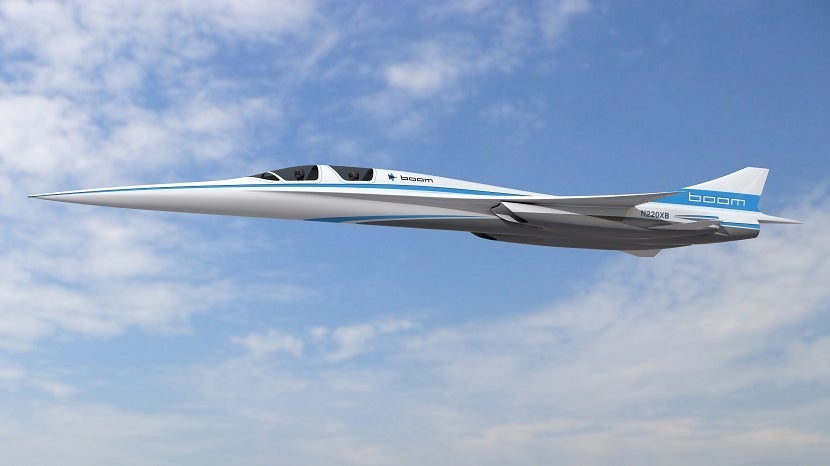
While NASA and a handful of aerospace startups have spent decades working on designs for supersonic private aircraft, Denver's Boom Technology is making tangible progress toward a new airliner that will be even faster than the Concorde. If the company delivers, travelers could be redeeming rewards or paying business-class rates to enjoy a next-gen ride in the sky.
TPG featured card

at Capital One's secure site
Terms & restrictions apply. See rates & fees.
| 5X miles | Earn 5X miles on hotels, vacation rentals and rental cars booked through Capital One Travel |
| 2X miles | Earn unlimited 2X miles on every purchase, every day |
Pros
- Stellar welcome offer of 75,000 miles after spending $4,000 on purchases in the first three months from account opening. Plus, a $250 Capital One Travel credit to use in your first cardholder year upon account opening.
- You'll earn 2 miles per dollar on every purchase, which means you won't have to worry about memorizing bonus categories
- Rewards are versatile and can be redeemed for a statement credit or transferred to Capital One’s transfer partners
Cons
- Highest bonus-earning categories only on travel booked via Capital One Travel
- LIMITED-TIME OFFER: Enjoy $250 to use on Capital One Travel in your first cardholder year, plus earn 75,000 bonus miles once you spend $4,000 on purchases within the first 3 months from account opening - that’s equal to $1,000 in travel
- Earn unlimited 2X miles on every purchase, every day
- Earn 5X miles on hotels, vacation rentals and rental cars booked through Capital One Travel
- Miles won't expire for the life of the account and there's no limit to how many you can earn
- Receive up to a $120 credit for Global Entry or TSA PreCheck®
- Use your miles to get reimbursed for any travel purchase—or redeem by booking a trip through Capital One Travel
- Enjoy a $50 experience credit and other premium benefits with every hotel and vacation rental booked from the Lifestyle Collection
- Transfer your miles to your choice of 15+ travel loyalty programs
- Top rated mobile app