Skip to content

Insider Series: How Do Flight Attendants Get Their Routes?
July 23, 2015
7 min read
Flight Routes
Insider Series: How Do Flight Attendants Get Their Routes?
The cards we feature here are from partners who compensate us when you are approved through our site, and this may impact how or where these products appear. We don’t cover all available credit cards, but our analysis, reviews, and opinions are entirely from our editorial team. Terms apply to the offers listed on this page. Please view our advertising policy and product review methodology for more information.

Our TPG Insider Flight Attendant Carrie A. Trey delves back into life at 35,000 feet, this time explaining how exactly flight attendants' hectic schedules work, and what goes into putting them together.

Hey there, friendly flight attendant — is this your regular route? Photo courtesy of Shutterstock.

“Is this your route?”

If I had a nickel for every time I was asked that question, I would definitely be doing something other than writing this article right now. (Like, say, sipping Ruinart Champagne on Necker Island after I bought it from Sir Richard Branson.) Instead, I’m here to save you from asking that question, because 99.9% of the time, the answer is “no.” Though they may fly one route a lot, flight attendants are not assigned to specific routes.

Now I imagine that some of you are now thinking, “My friend Trina flies for XYZ Airlines and she says she only flies to Tokyo on Tuesdays.” And yes, that’s possible — but allow me to explain how bidding works, how schedules are awarded and why that still is not “her route."

Many European carriers have crews based in Asia and India, and sometimes South America. They're local crews who fill in one to two positions on the trip so that there will be attendants onboard who can communicate easily with foreign-language speakers. For example, Virgin Atlantic had a Hong Kong (HKG) crew base that often took over several positions on their HKG-Sydney (SYD) route; these same HKG-based flight attendants would also sometimes go to London Heathrow (LHR), Shanghai (PVG), Tokyo-Narita (NRT) or even North America. In other words, even though they mostly flew HKG-SYD, they did have other trips as well, and no one flight attendant was dedicated to just one route.
A flight attendant's routes are generally based on a combination of bidding and seniority and aren't guaranteed. Image courtesy of Shutterstock.

Fortunately, the United States being the cultural melting pot that it is, airlines here have little use for foreign bases because it's easier to source multi-lingual crew within the country. American Airlines has bases in South America, and Delta in Asia, but it’s not for a lack of US-based staff who speak other languages. (Delta inherited those bases from NorthWest in their merger and is actually closing them down in favor of flying with all US-based crews.) At United (sub-Continental or sCO), for instance, if you're qualified as a speaker of German, you can be based in Newark (EWR) or Houston (IAH) and you’ll fly mostly to German-speaking destinations; however, you'll still have the opportunity to pick up trips to other places.

Bidding works a few different ways. There is line-bidding, which is still done at American Airlines, Southwest and United (sCO). Flight attendants bid for a pre-assembled line of trips, which are then awarded in seniority order. So a flight attendant flying out of American’s domestic base at Dallas/Fort Worth (DFW) might have trips for all of April that are essentially the same: DFW-Chicago (ORD)-Los Angeles (LAX) on day one, LAX-New York-JFK on day two, and JFK-Miami (MIA)-DFW on day three. So all month long, that flight attendant could potentially be working the same flights. However, what you can hold every month does change, and flight attendants also have the flexibility to trade trips amongst themselves.

Out of the EWR international base, a line might be EWR-PVG every Tuesday of the month, returning on Thursday — as you'll see on line 9 on the United Airlines bid packet pictured below. So an attendant could potentially be flying the same trip for a month. However, what an attendant can hold each month depends on seniority and changes constantly, as colleagues take vacation or head out on leaves — and some folks just enjoy bidding for different things every month. Variety is the spice of life, after all.
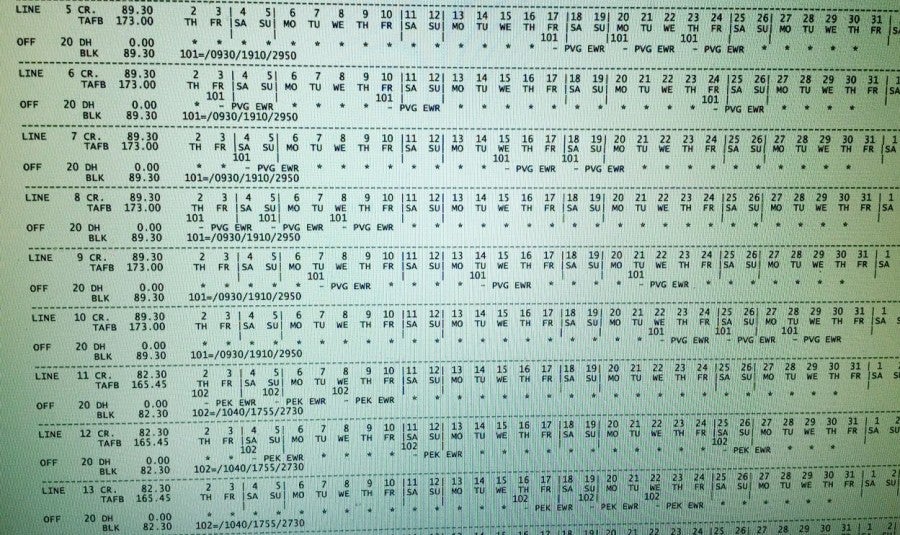
An example of lines in a United Airlines (sub-Continental, or sCO) bid packet.

In other words, that flight attendant pal of yours who flies Tokyo on Tuesdays may well be flying that route this month, but if her friend from training who is one number senior decides next month that she wants Tokyo, the company will award it to the senior and your friend Trina will have to fly somewhere else.

Daily Newsletter
Reward your inbox with the TPG Daily newsletter
Join over 700,000 readers for breaking news, in-depth guides and exclusive deals from TPG’s experts

Also, in case of irregular operations (e.g., weather, delays, mechanical issues — all the things that we hate to think about but we know happen all too often), scheduling might shuffle crews around if need be. Most US airlines are fairly liberal about letting their crews swap trips amongst themselves, so the line you're awarded at the beginning of the month may not be at all reflective of what you’ll actually end up flying.

At Southwest, as you can see in the example of a bid packet below, you might have a trip every Monday (as in line 397), but the layovers and legs flown will likely all be different.
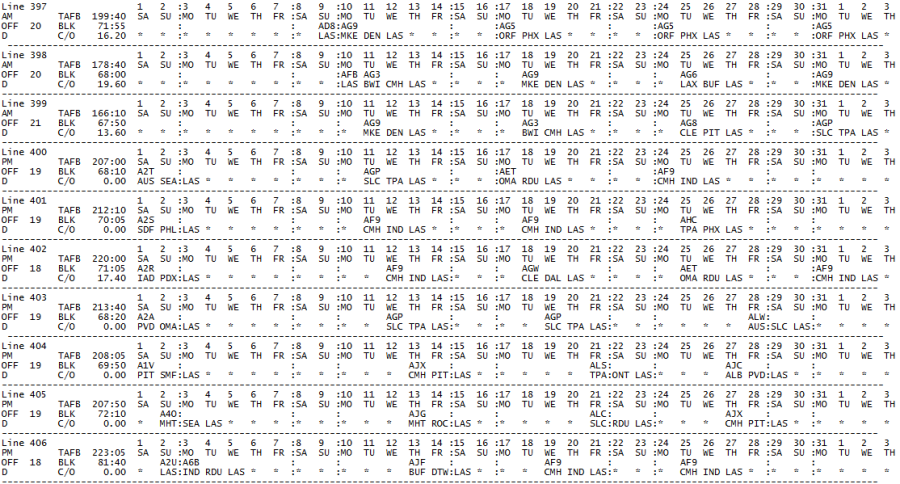
An example of lines in a Southwest bid packet.

Another system is called the Preferential Bidding System (PBS). This is a more popular system than line-bidding, as it provides more benefit to the company by leaving fewer trips uncovered. Delta, JetBlue and Air Canada use this system, as do most airlines in Europe and Asia. PBS allows flight attendants to input a series of requests, then does its best to adhere to those requests when awarding schedules, honoring them in seniority order. This system is bound by certain built-in constraints, such as a schedule value (that is, how much the airline needs each flight attendant to work in order to cover the entire operation), language qualifications, etc. Some airlines award schedules once a month, and some (like KLM) award them on a rolling basis.

Regardless of how bids are made, a lot goes into building a schedule. There are minimum time-off restrictions based on the length of a trip flown, minimum days off, and in Europe, flight attendants aren't allowed to work more than 900 hours a year. (There are similar restrictions in place in the United States for pilots, but nothing is officially on the books for flight attendants.)

At Cathay Pacific, for instance, crews are only allowed to fly two trans-polar trips a month, in order to reduce crews' exposure to harmful radiation. At KLM, the length of a trip dictates the number of days off that a crew member is required to have off after that trip. A transatlantic trip to the East Coast of the US, for instance, must have three calendar days off built in after the trip, whereas a longer trip [e.g., to Lima (LIM) or Singapore (SIN)] will have eight days of rest built in before the crew member is legally allowed to fly again.

The result of these various scheduling systems, changing network/operational demands and government regulations mean that no flight attendant has a regular route. Most airlines do use something more along the lines of PBS, and at some airlines — such as South African Airways, for instance — crews are just given a schedule every month and must fly what they get.

Just because most flight attendants don't have their pick of routes doesn't mean they won't sometimes end up in paradise. Photo courtesy of Shutterstock.

So chances are that no, your particular flight attendant is not flying his/her specified route, unless said attendant has seniority, in which there's a good chance this route is his or her comfort zone. And if the attendant is lucky enough to fly for a US airline that has a complex bidding system that rewards seniority, then yes, he or she will fly the same thing pretty often.

The rest of us simply get to live the dream and see the world — which suits me just fine!

TPG featured card

Best for dining at restaurants
TPG Editor‘s Rating
4 / 5
Go to review
Apply for American Express® Gold Card
at American Express's secure site

Rewards

1 - 4X points

Intro offer

As High As 100,000 points. Find Out Your Offer.

Annual Fee

$325

Recommended Credit

Excellent to Good

Why We Chose It

There’s a lot to love about the Amex Gold. It’s a fan favorite thanks to its fantastic bonus-earning rates at restaurants worldwide and at U.S. supermarkets. If you’re hitting the skies soon, you’ll also earn bonus Membership Rewards points on travel. Paired with up to $120 in Uber Cash annually (for U.S. Uber rides or Uber Eats orders, card must be added to Uber app and you can redeem with any Amex card), up to $120 in annual dining statement credits to be used with eligible partners, an up to $84 Dunkin’ credit each year at U.S. Dunkin Donuts and an up to $100 Resy credit annually, there’s no reason that foodies shouldn’t add the Amex Gold to their wallet. These benefits alone are worth more than $400, which offsets the $325 annual fee on the Amex Gold card. Enrollment is required for select benefits. (Partner offer)

Pros

  • 4 points per dollar spent on dining at restaurants worldwide and U.S. supermarkets (on the first $50,000 in purchases per calendar year; then 1 point per dollar spent thereafter and $25,000 in purchases per calendar year; then 1 point per dollar spent thereafter, respectively)
  • 3 points per dollar spent on flights booked directly with the airline or with amextravel.com
  • Packed with credits foodies will enjoy
  • Solid welcome bonus

Cons

  • Not as useful for those living outside the U.S.
  • Some may have trouble using Uber and other dining credits
  • You may be eligible for as high as 100,000 Membership Rewards® Points after you spend $6,000 in eligible purchases on your new Card in your first 6 months of Card Membership. Welcome offers vary and you may not be eligible for an offer. Apply to know if you’re approved and find out your exact welcome offer amount – all with no credit score impact. If you’re approved and choose to accept the Card, your score may be impacted.
  • Earn 4X Membership Rewards® points per dollar spent on purchases at restaurants worldwide, on up to $50,000 in purchases per calendar year, then 1X points for the rest of the year.
  • Earn 4X Membership Rewards® points per dollar spent at US supermarkets, on up to $25,000 in purchases per calendar year, then 1X points for the rest of the year.
  • Earn 3X Membership Rewards® points per dollar spent on flights booked directly with airlines or on AmexTravel.com.
  • Earn 2X Membership Rewards® points per dollar spent on prepaid hotels and other eligible purchases booked on AmexTravel.com.
  • Earn 1X Membership Rewards® point per dollar spent on all other eligible purchases.
  • $120 Uber Cash on Gold: Add your Gold Card to your Uber account and get $10 in Uber Cash each month to use on orders and rides in the U.S. when you select an American Express Card for your transaction. That’s up to $120 Uber Cash annually. Plus, after using your Uber Cash, use your Card to earn 4X Membership Rewards® points for Uber Eats purchases made with restaurants or U.S. supermarkets. Point caps and terms apply.
  • $84 Dunkin' Credit: With the $84 Dunkin' Credit, you can earn up to $7 in monthly statement credits after you enroll and pay with the American Express® Gold Card at U.S. Dunkin' locations. Enrollment is required to receive this benefit.
  • $100 Resy Credit: Get up to $100 in statement credits each calendar year after you pay with the American Express® Gold Card to dine at U.S. Resy restaurants or make other eligible Resy purchases. That's up to $50 in statement credits semi-annually. Enrollment required.
  • $120 Dining Credit: Satisfy your cravings, sweet or savory, with the $120 Dining Credit. Earn up to $10 in statement credits monthly when you pay with the American Express® Gold Card at Grubhub, The Cheesecake Factory, Goldbelly, Wine.com, and Five Guys. Enrollment required.
  • Explore over 1,000 upscale hotels worldwide with The Hotel Collection and receive a $100 credit towards eligible charges* with every booking of two nights or more through AmexTravel.com. *Eligible charges vary by property.
  • No Foreign Transaction Fees.
  • Annual Fee is $325.
  • Terms Apply.
Apply for American Express® Gold Card
at American Express's secure site
Terms & restrictions apply. See rates & fees
Best for dining at restaurants
TPG Editor‘s Rating
4 / 5
Go to review

Rewards Rate

4XEarn 4X Membership Rewards® points per dollar spent on purchases at restaurants worldwide, on up to $50,000 in purchases per calendar year, then 1X points for the rest of the year.
4XEarn 4X Membership Rewards® points per dollar spent at US supermarkets, on up to $25,000 in purchases per calendar year, then 1X points for the rest of the year.
3XEarn 3X Membership Rewards® points per dollar spent on flights booked directly with airlines or on AmexTravel.com.
2XEarn 2X Membership Rewards® points per dollar spent on prepaid hotels and other eligible purchases booked on AmexTravel.com.
1XEarn 1X Membership Rewards® point per dollar spent on all other eligible purchases.
  • Intro Offer

    As High As 100,000 points. Find Out Your Offer.
  • Annual Fee

    $325
  • Recommended Credit

    Excellent to Good

Why We Chose It

There’s a lot to love about the Amex Gold. It’s a fan favorite thanks to its fantastic bonus-earning rates at restaurants worldwide and at U.S. supermarkets. If you’re hitting the skies soon, you’ll also earn bonus Membership Rewards points on travel. Paired with up to $120 in Uber Cash annually (for U.S. Uber rides or Uber Eats orders, card must be added to Uber app and you can redeem with any Amex card), up to $120 in annual dining statement credits to be used with eligible partners, an up to $84 Dunkin’ credit each year at U.S. Dunkin Donuts and an up to $100 Resy credit annually, there’s no reason that foodies shouldn’t add the Amex Gold to their wallet. These benefits alone are worth more than $400, which offsets the $325 annual fee on the Amex Gold card. Enrollment is required for select benefits. (Partner offer)

Pros

  • 4 points per dollar spent on dining at restaurants worldwide and U.S. supermarkets (on the first $50,000 in purchases per calendar year; then 1 point per dollar spent thereafter and $25,000 in purchases per calendar year; then 1 point per dollar spent thereafter, respectively)
  • 3 points per dollar spent on flights booked directly with the airline or with amextravel.com
  • Packed with credits foodies will enjoy
  • Solid welcome bonus

Cons

  • Not as useful for those living outside the U.S.
  • Some may have trouble using Uber and other dining credits
  • You may be eligible for as high as 100,000 Membership Rewards® Points after you spend $6,000 in eligible purchases on your new Card in your first 6 months of Card Membership. Welcome offers vary and you may not be eligible for an offer. Apply to know if you’re approved and find out your exact welcome offer amount – all with no credit score impact. If you’re approved and choose to accept the Card, your score may be impacted.
  • Earn 4X Membership Rewards® points per dollar spent on purchases at restaurants worldwide, on up to $50,000 in purchases per calendar year, then 1X points for the rest of the year.
  • Earn 4X Membership Rewards® points per dollar spent at US supermarkets, on up to $25,000 in purchases per calendar year, then 1X points for the rest of the year.
  • Earn 3X Membership Rewards® points per dollar spent on flights booked directly with airlines or on AmexTravel.com.
  • Earn 2X Membership Rewards® points per dollar spent on prepaid hotels and other eligible purchases booked on AmexTravel.com.
  • Earn 1X Membership Rewards® point per dollar spent on all other eligible purchases.
  • $120 Uber Cash on Gold: Add your Gold Card to your Uber account and get $10 in Uber Cash each month to use on orders and rides in the U.S. when you select an American Express Card for your transaction. That’s up to $120 Uber Cash annually. Plus, after using your Uber Cash, use your Card to earn 4X Membership Rewards® points for Uber Eats purchases made with restaurants or U.S. supermarkets. Point caps and terms apply.
  • $84 Dunkin' Credit: With the $84 Dunkin' Credit, you can earn up to $7 in monthly statement credits after you enroll and pay with the American Express® Gold Card at U.S. Dunkin' locations. Enrollment is required to receive this benefit.
  • $100 Resy Credit: Get up to $100 in statement credits each calendar year after you pay with the American Express® Gold Card to dine at U.S. Resy restaurants or make other eligible Resy purchases. That's up to $50 in statement credits semi-annually. Enrollment required.
  • $120 Dining Credit: Satisfy your cravings, sweet or savory, with the $120 Dining Credit. Earn up to $10 in statement credits monthly when you pay with the American Express® Gold Card at Grubhub, The Cheesecake Factory, Goldbelly, Wine.com, and Five Guys. Enrollment required.
  • Explore over 1,000 upscale hotels worldwide with The Hotel Collection and receive a $100 credit towards eligible charges* with every booking of two nights or more through AmexTravel.com. *Eligible charges vary by property.
  • No Foreign Transaction Fees.
  • Annual Fee is $325.
  • Terms Apply.