Sean Cudahy is an aviation reporter covering news about airlines, frequent flyer programs and consumer travel issues.
October 6, 2025 • 7 min read
The cards we feature here are from partners who compensate us when you are approved through our site, and this may impact how or where these products appear. We don't cover all available credit cards, but our analysis, reviews, and opinions are entirely from our editorial team. Terms apply to the offers listed on this page. Please view our advertising policy and product review methodology for more information.
Editorial note: This story has been updated with new information.
Editorial disclaimer: Opinions expressed here are the author's alone, not those of any bank, credit card issuer, airline or hotel chain, and have not been reviewed, approved or otherwise endorsed by any of these entities.
Comments
By commenting, you agree to our Community Guidelines to help create a positive space for conversation. The responses below are not provided or commissioned by the bank advertiser, our partners, or The Points Guy (“TPG”). They have not been reviewed, approved, or otherwise endorsed by any of these parties. All responses are submitted by individual contributors, and neither the bank advertiser, our partners, nor TPG are responsible for ensuring that all posts and/or questions are answered.
Related stories
Quick summary
A prolonged federal government shutdown is causing increased air traffic controller absences, leading to potential flight delays at major airports.
Essential Air Service subsidies, which support flights to smaller communities, may run out soon, putting some regional routes at risk.
Transportation Security Administration officers and air traffic controllers are working without pay, though significant security checkpoint delays have not yet been reported.
Travelers are advised to arrive early at airports and avoid tight connections, as delays could worsen if staffing shortages continue.
What to consider
Essential federal employees are working without pay and lack support from furloughed staff, which may impact efficiency.
The MyTSA app will not be updated during the shutdown, so travelers cannot rely on it for real-time checkpoint wait times.
Federal subsidies for regional routes may lapse soon, leaving airlines to decide whether to suspend service to smaller airports.
What you'll miss from the article
Detailed advice on minimizing travel disruptions and updates on how the shutdown could further affect specific airports and routes.
Generated by AI with support from our editorial team.
Flight delays could soon pick up — and service to some smaller American communities may be in jeopardy as the federal government shutdown stretches into a second week.
U.S. Secretary of Transportation Sean Duffy confirmed Monday that control towers at airports across the country have seen a “slight tick up” in air traffic controllers staying home from work in recent days.
That included California's Hollywood-Burbank Airport (BUR), which on Monday reportedly went unmanned for hours due to staffing, with air traffic control handled by the Federal Aviation Administration's San Diego facility.
“There’s been one facility one day, another facility another day,” Duffy said, speaking during a news conference at Newark Liberty International Airport (EWR). “Some areas, there’s been a 50% reduction in some of the staffing. We’re tracking it. And we take the appropriate action necessary to make sure our skies are safe.”
U.S. Secretary of Transportation Sean Duffy speaks Monday at Newark Liberty International Airport (EWR). MICHAEL NAGLE/BLOOMBERG VIA GETTY IMAGES
Aviation industry leaders had feared a spike in FAA employees calling off work after the federal government entered a shutdown on Oct. 1, with no funding bill passed by Congress.
Air traffic controllers are among the thousands of essential federal workers expected to continue reporting to work during a shutdown, but without a paycheck. In early 2019, a weekslong shutdown led to scores of FAA workers calling off and resulted in mounting flight delays — travel woes that ultimately helped bring the stalemate in Washington to an end.
So far, Duffy said the air traffic control call-outs weren’t widespread. But if the problems worsen, he added, the FAA could slow the flow of planes — which would likely trigger flight delays, especially at the nation’s busiest airports.
Air traffic control staffing is already a major problem
Critical FAA facilities already face significant staffing challenges. Controllers regularly work six-day weeks and mandatory overtime.
The nation’s largest air traffic controllers union on Sunday encouraged its members to continue reporting to work during the shutdown, and denounced “any coordinated activity that disrupts the national airspace system,” alluding to unauthorized absences.
TSA officers working without pay
Also expected to work without pay: Transportation Security Administration officers.
TSA officers at Dallas Love Field (DAL) in Texas. SHELBY TAUBER/BLOOMBERG VIA GETTY IMAGES
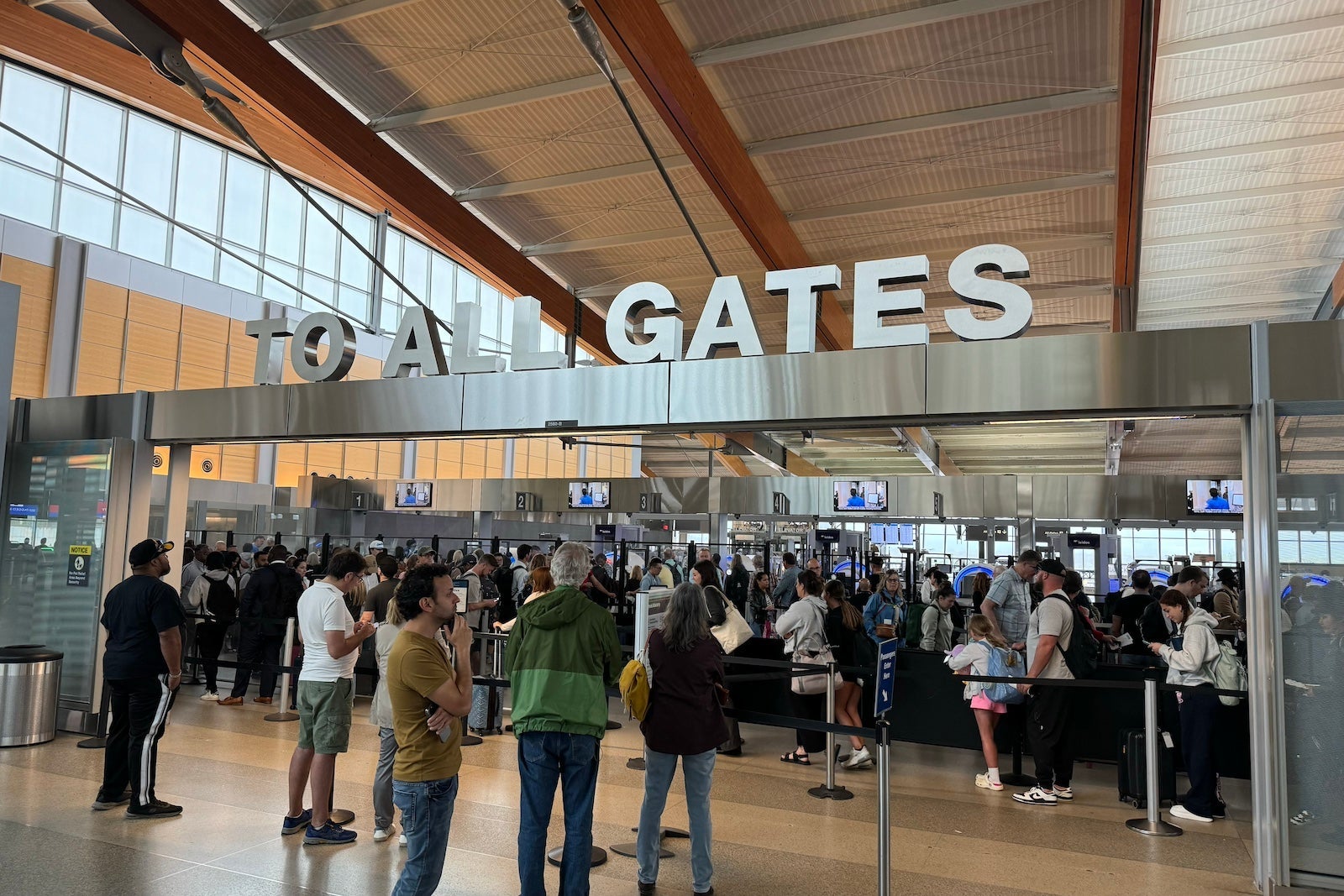
At the time of publication, TPG had not yet heard reports of significant security checkpoint delays. However, we should warn: Security backups cropped up during the last shutdown, so it’s possible travelers could run into longer wait times at TSA checkpoints if the shutdown drags on.
Visiting several airport checkpoints late last week, overall TSA staffing levels appeared, in some cases, to be a little less than what I'd normally expect to see as an avid traveler who's at airports most weeks.
We should note: essential federal employees who are still reporting to work are currently without the assistance of the critical, furloughed support staff who help government services run more efficiently.
“TSA has not experienced any delay in operations due to callouts and remains fully capable of facilitating safe and secure travel for passengers," a spokesperson for the agency told TPG late Tuesday.
Routes to smaller communities in jeopardy
While some flyers could face travel delays, other airports are at risk of losing flights altogether in the coming days.
Federal subsidies for Essential Air Service run out on Sunday without Congressional intervention, Duffy said on Monday. That funding supports airline routes to underserved airports, often in smaller communities where a carrier might not otherwise see a business reason to fly.
Williamsport Regional Airport (IPT) in Pennsylvania. HEATHER AINSWORTH/WASHINGTON POST VIA GETTY IMAGES
Airlines would likely get the final say on whether a particular route would go on hiatus during a shutdown.
The state with the most subsidized routes: Alaska.
Late Monday, Alaska Airlines told TPG it would "continue operating reliable flights as scheduled" during the shutdown to the half-dozen Alaskan cities it serves with the help of federal reimbursement.
"This program is an essential economic lifeline for 169 airports who are often hit the hardest whenever there is disruption in the National Airspace System," the Regional Airline Association said in a statement to TPG Tuesday.
Here’s what to know if you’re flying in the coming days.
Is air travel safe during a shutdown?
Yes, leaders emphasized Monday. “It is very, very safe,” said Frank McIntosh, chief operating officer of the FAA’s Air Traffic Organization.
However, the FAA warned that keeping the skies safe may require control towers to slow the flow of planes if ATC staffing levels drop. That’s when delays happen, as we’ve seen frequently in recent years at heavily congested Northeastern airports.
ROBERTO SCHMIDT/AFP VIA GETTY IMAGES
A thunderstorm or other weather disruption would likely make wider cascading delays far more likely.
Get to the airport early
To guard against potential backups at TSA checkpoints, I’d suggest getting to the airport earlier than you normally do. And don’t rely on the ordinarily handy MyTSA app to monitor checkpoint wait times. The app will not be updated during the lapse in federal funding, TSA warns.
MYTSA APP
Avoid tight connections
Easier said than done if you’ve already booked your trip, but the best way to keep shutdown-related flight trouble from turning into a major travel disruption is to fly nonstop — or at least avoid a tight connection.
Mass flight cancellations are a lot less likely than a 45-minute delay caused by a prolonged wait on the taxiway. And the latter is only a major problem if it causes you to miss your connecting flight.
An American Airlines aircraft at Dallas Fort Worth International Airport (DFW). SEAN CUDAHY/THE POINTS GUY
Watch for airline travel advisories
We have not yet seen major flight woes, to be clear.
If mass delays start popping up at certain airports, keep an eye out for any communication from your airline. Should travel strain grow, carriers may issue travel waivers allowing you to change or rebook your trip.
By commenting, you agree to our Community Guidelines to help create a positive space for conversation. The responses below are not provided or commissioned by the bank advertiser, our partners, or The Points Guy (“TPG”). They have not been reviewed, approved, or otherwise endorsed by any of these parties. All responses are submitted by individual contributors, and neither the bank advertiser, our partners, nor TPG are responsible for ensuring that all posts and/or questions are answered.