
The C-Series aircraft, a single-aisle twinjet which seats up to 150 people, has been in the headlines recently when the US Department of Commerce issued a preliminary ruling, last week, that would levy a 219.63% tariff on every C-Series airliner imported into the US. The ruling stemmed from a complaint by Boeing that the Canada-based Bombardier had engaged in dumping, or artificially keeping prices low to win orders, thanks to government subsidies. According to Boeing, its Canadian rival was able to offer Delta the CS100 at substantially lower prices than the 737 thanks to those subsidies. Bombardier disputes this, and the tariff ruling is not yet final. (Delta CEO Ed Bastian called the ruling "absurd", and expressed confidence that his airline will get its new jet at the price it had agreed upon.)
In the meantime, if you want to experience the C-Series, you can go for either Swiss, which flies it all over Europe, including to London (LCY), Madrid (MAD) and Oslo (OSL), or AirBaltic, a Latvian airline that's betting heavily on the CS300, with 7 in service and 13 on order.
Swiss has a total of 30 C-Series on order and says the entry into service was "perfect," with the jet becoming an instant hit with passengers, mainly due to its spacious cabin.
The Points Guy's Zach Honig had a look at the CS100 at the Farnborough air show last year, and found it to be "a huge step up from just about any regional jet." A tour of the aircraft earlier this year at the Zurich airport (ZRH) and a special flight over the Alps confirmed that impression.
The engines are visibly larger than the turbofans installed on most jets in this class — they are Pratt & Whitney 1500G geared fans, which according to their maker save 20% fuel compared to previous similar engines.
A close look reveals the curved fan blades often seen on the latest generation of jet engines. Swiss says that compared to the Avro RJ100 it replaces, the Cs100 reduces CO2 output by 90,000 tons a year.
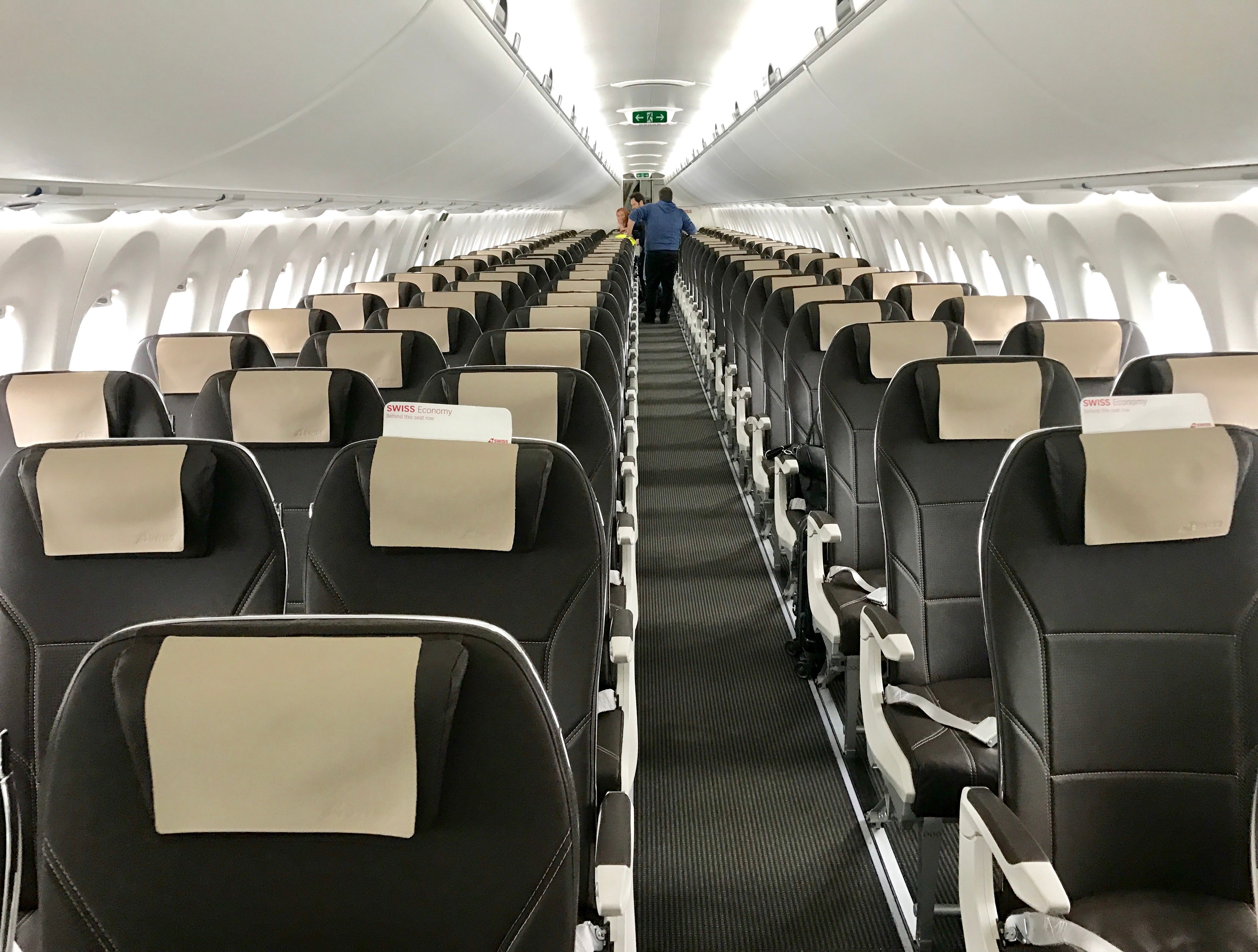
Swiss CS100s have a total of 125 seats — 20 in Business Class and 105 in Economy Class. C-Series aircraft are 5-abreast, in a 2-3 configuration. As a result, the cabin feels more spacious than a regular 3-3 short-haul aircraft. The interior is very elegant, with brown and beige tones similar to other interiors in the airline's fleet.
The C-Series has one of the widest aisles, adding to the feeling of space. All seats throughout the aircraft in both Business & Economy have a pitch of 30 inches and are 18.5 inches wide — not an outstanding pitch, but wider than most. Still, 30 inches is more than some legacy airlines in Europe; Swiss parent company Lufthansa has 28-inch pitch on its new A320 NEO.
There isn't any form of divider between Business Class and Economy, simply a plastic card stating "Economy Class behind this row." This gives Swiss the opportunity to extend or reduce the size of the Business Class cabin, according to demand. In Business Class, only three seats per row are sold: C and E seats are blocked. Only the seats in yellow on the diagram below are available. On its single-aisle Airbuses, Swiss does the same by blocking the middle seats in each row of six.
Business class passengers get the Swiss Euro Biz class service, which includes a full dining service — one meal served on crockery, starter, dessert also on tray — pre-take off drinks and refresh towel.
The CS100 features large windows positioned much closer together compared with other single aisle aircraft, allowing plenty of daylight into the cabin.
This is what 30 inches of legroom looks like:
Large drop-down overhead bins are the same size as those you'd expect on a new widebody aircraft, with plenty of room for cabin baggage.
Perhaps one of the coolest features of the CS100 are the mini overhead screens. The screens are used prior to departure so show the safety video, and then throughout the flight to show videos about Switzerland and Swiss (without audio).
During flight, you can appreciate how bright the cabin is. In the photo below, the minimum light setting option was on, letting natural daylight illuminate the cabin.
Here's the rear galley.
Including the view from the rear emergency exit.
The C Series features a fully digital flight deck, including large LCD displays, and a heads up display (HUD) for both pilots.
The cockpit design reduces the number of monitor displays by integrating flight systems to be displayed on two main screens per pilot.
Other perks of this aircraft include larger bathrooms compared with other single aisle airplanes. They contribute to make the Swiss CS100 a very comfortable aircraft, with a sophisticated interior. It feels more like a widebody than a narrowbody thanks to the 2-3 configuration, wide 20-inch aisle and spacious seat width. And the very quiet engines add to the serene atmosphere onboard.
Have you flown Swiss' C Series aircraft?