Boat vs. ship: What's the difference? The annoying mistake some cruisers keep making


Vacationing on a cruise ship? That's great, but for the love of all that is nautical, please don't call it a boat.
Modern-day cruise behemoths have earned the right to be called ships. The name is grand, it implies stature, and it lets everyone know that there's some sort of official larger purpose, whether it's the transportation of goods or of people.
What's the official difference between a boat and a ship? Technically, there isn't one that's universally accepted. Everyone seems to have their own ideas about what defines each, with no final verdict. Some say it has to do with size or tonnage, while others argue it's about how many masts the vessel has or whether it's a submarine (which, I'm told, is always a boat). Still others claim it's more about the bodies of water on which a vessel is designed to spend its days.
Regardless, the one certainty is that you'll sound like you have no idea what you're talking about if you refer to a cruise vessel — except maybe a riverboat — as a boat instead of a ship. In that vein, to help you understand the differences, let's take a look at some of the most popular differentiators, depending on whom you ask.
Vessel size

When you ask the average person what makes a vessel a ship versus a boat, they'll often tell you that it comes down to size. A ship is big; a boat is small. That seems to be the most common consensus, but those terms are arbitrary. What constitutes large and small?
In researching, I've discovered there's no official length at which a vessel becomes a ship. Sources cite everything from 100 feet to 200 feet in length and everything in between.
In terms of height, some seafarers insist that any vessel with more than one deck is a ship, and anything with only a single deck is a boat, as presented by The Guardian via a reader in the paper's Semantic Enigmas section.
Another common size-related refrain — one that's used by the United States Naval Institute — is that if a vessel is large enough to carry other vessels, it's a ship.
"In general, a boat is a watercraft ... that is small enough to be carried on board a larger one, and that larger one is a ship," said Lt. Cmdr. Thomas J. Cutler in a blog post on the USNI's website. "This is sometimes expressed this way: 'A ship can carry a boat, but a boat can never carry a ship.'"

Vessel tonnage
Tonnage is another determinant some entities use to qualify vessels as ships instead of boats. In fact, the maritime information website Marine Insight claims it's one of the most important factors to consider.
Vessels of more than 500 tons, regardless of size, are ships, according to the site.
Where the vessel sails

I recently sailed on my first U.S. river cruise, during which a lecturer explained that boats are specifically built for inland waterways, such as lakes and rivers. "This is a boat, despite its size," she said, also noting that it carries lifeboats (which would make it a ship by some definitions).
Supporting this theory is Scientific American, which quotes The Straight Dope (Cecil Adams, the self-proclaimed smartest man in the world) as saying, "With regard to motorized craft, a ship is a large vessel intended for oceangoing or at least deep-water transport, and a boat is anything else."
How the vessel corners
A handful of online query results say another way to tell a ship from a boat is by observing the direction in which it leans when it turns.
"A U.S. Navy rule of thumb is that ships lean towards the outside of a sharp turn, while boats lean towards the inside," The Maritime Post said. For a more relatable visual, think about a motorcycle versus a car. The former leans in as you go around a turn; the latter leans away from the center of the turn.
Vessel propulsion and design
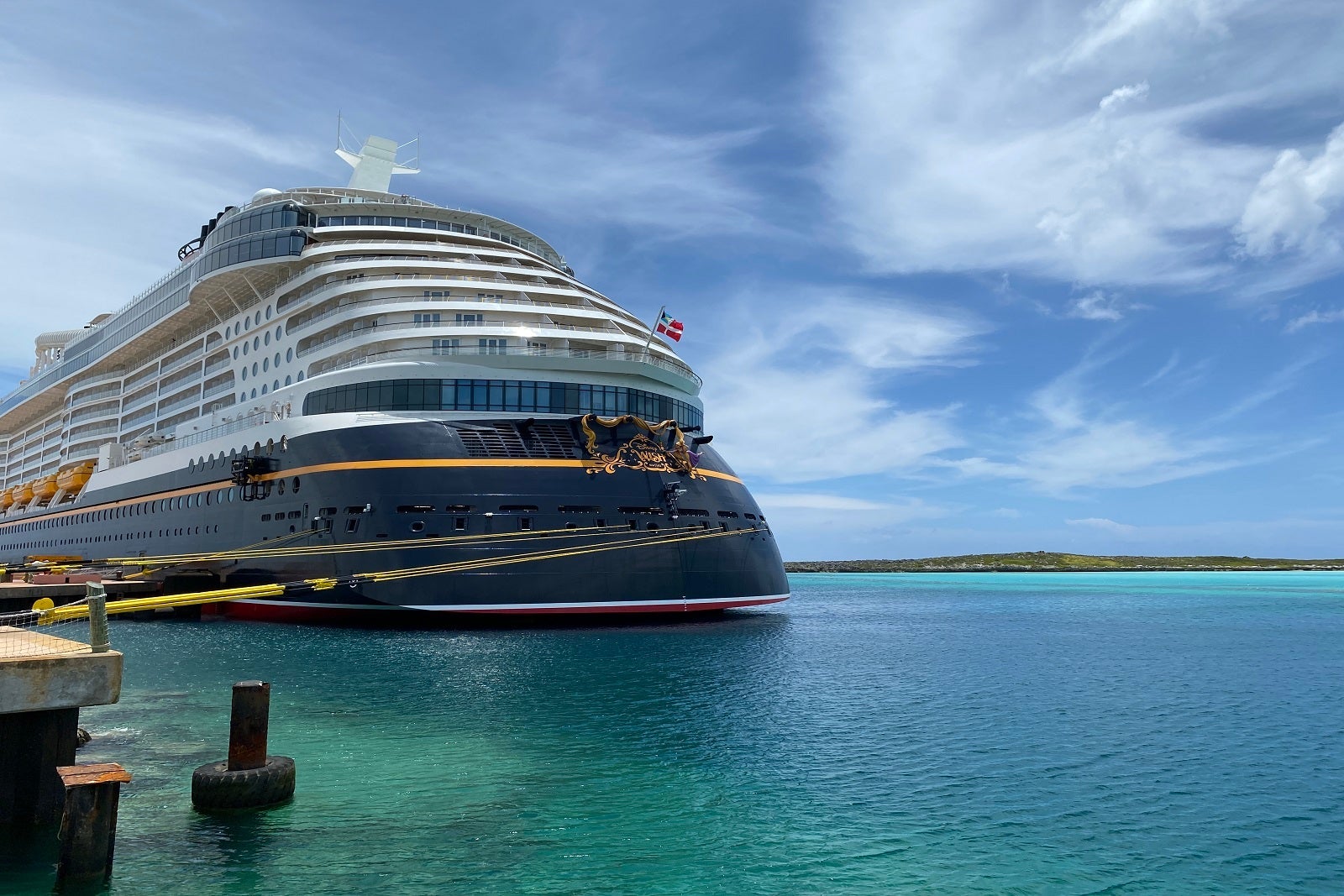
As you might expect from a larger vessel, ships often have more complex construction than boats. They also have more machinery on board than boats do, whether that's in the way of navigation or engine room accouterments.
Further, how they're propelled might differ. Most modern-day ships are powered by engines, whereas boats can be moved by anything from oars or sails to engines, according to Marine Insight.
Number of masts on the vessel
In terms of sailing vessels, if a rig has three masts or more, it's considered a ship, per the New Bedford Whaling Museum in Massachusetts. To qualify, it must also have square sails on all masts.
Obviously, most modern-day cruise ships don't have masts. (Exceptions are ships from Windstar and Star Clippers.) Although this rule is less relevant today, it does come up frequently in maritime circles when discussing the difference between a ship and a boat.
Bottom line
There's no hard-and-fast rule when it comes to determining whether a vessel is a ship or a boat. Generally, the most common ideas about this seem to revolve around size: tonnage, number of decks or whether or not the vessel can carry other boats.
Lots of people will have opinions about the "correct" criteria, but the bottom line is that you should never refer to a cruise ship as a boat if it carries travelers on the ocean for vacation.
Got more cruise questions? TPG has answers:
- Man overboard: Why do people fall off cruise ships?
- What is baked Alaska, and why is it paraded around cruise ships?
- What are the largest cruise ships in the world?
- What is a lido deck on a cruise ship?
- What is tendering on a cruise ship?
- What's the difference between a cruise concierge and a butler?
- What is a gentleman host on a cruise?
- What is the Jones Act and how does it affect cruise ships?
- What's a cruise cabin guarantee and will it save you money?
TPG featured card
at American Express's secure site
Terms & restrictions apply. See rates & fees.
| 4X | Earn 4X Membership Rewards® points per dollar spent on purchases at restaurants worldwide, on up to $50,000 in purchases per calendar year, then 1X points for the rest of the year. |
| 4X | Earn 4X Membership Rewards® points per dollar spent at US supermarkets, on up to $25,000 in purchases per calendar year, then 1X points for the rest of the year. |
| 5X | Earn 5X Membership Rewards® points on prepaid hotel stays booked through AmexTravel.com or the Amex Travel App™. |
| 3X | Earn 3X Membership Rewards® points on flights booked through AmexTravel.com, the Amex Travel App™, or purchased directly from airlines. |
| 2X | Earn 2X Membership Rewards® points on prepaid car rentals booked through AmexTravel.com or the Amex Travel App™ and cruises booked and paid through AmexTravel.com. |
| 1X | Earn 1X Membership Rewards® point per dollar spent on all other eligible purchases. |
Pros
- Valuable dining and food-related credits
- Flexible rewards with airline and hotel transfer partners
- Multiple travel and purchase protections
- No foreign transaction fees
- Access to Amex Offers for additional savings (enrollment required)
Cons
- Not as useful for those living outside the U.S.
- Some may have trouble using Uber and other dining credits
- You may be eligible for as high as 100,000 Membership Rewards® Points after you spend $8,000 in eligible purchases on your new Card in your first 6 months of Card Membership. Welcome offers vary and you may not be eligible for an offer. Apply to know if you’re approved and find out your exact welcome offer amount – all with no credit score impact. If you’re approved and choose to accept the Card, your score may be impacted.
- Earn 4X Membership Rewards® points per dollar spent on purchases at restaurants worldwide, on up to $50,000 in purchases per calendar year, then 1X points for the rest of the year.
- Earn 4X Membership Rewards® points per dollar spent at US supermarkets, on up to $25,000 in purchases per calendar year, then 1X points for the rest of the year.
- Earn 5X Membership Rewards® points on prepaid hotel stays booked through AmexTravel.com or the Amex Travel App™.
- Earn 3X Membership Rewards® points on flights booked through AmexTravel.com, the Amex Travel App™, or purchased directly from airlines.
- Earn 2X Membership Rewards® points on prepaid car rentals booked through AmexTravel.com or the Amex Travel App™ and cruises booked and paid through AmexTravel.com.
- Earn 1X Membership Rewards® point per dollar spent on all other eligible purchases.
- Pay It® lets you tap in the American Express® App to quickly pay for small purchase amounts throughout the month and still earn rewards the way you usually do. Plan It® gives you the option to split up big purchases into equal monthly payments with a fixed fee. You’ll know upfront exactly how much you’ll pay.
- $120 Dining Credit: Earn up to a total of $10 in statement credits monthly when you pay with the Gold Card at Grubhub (including Seamless), Buffalo Wild Wings, Five Guys, The Cheesecake Factory, and Wonder. This can be an annual savings of up to $120. Enrollment required.
- $100 Resy Credit: Get up to $100 in statement credits each calendar year at over 10,000 qualifying U.S. Resy restaurants after you pay for eligible purchases with the American Express® Gold Card. That’s up to $50 in statement credits semi-annually. Enrollment required.
- $84 Dunkin' Credit: Earn up to $7 in monthly statement credits after you pay with the American Express® Gold Card at U.S. Dunkin’ locations. Enrollment required.
- $120 Uber Cash on Gold: Enjoy up to $120 in Uber Cash annually with your Gold Card. Just add your Card to your Uber account and you'll get $10 in Uber Cash each month to use on orders and rides in the U.S. when you select an Amex Card for your transaction.
- Enjoy complimentary Hertz Five Star® Status benefits like skipping the counter at select locations, adding an additional driver at no additional cost*, and vehicle upgrades**. Benefit enrollment and Hertz Gold+ registration are required. *Additional drivers must meet standard rental qualifications and must be a spouse or domestic partner to qualify as complimentary. Other additional drivers subject to fees. **Benefits are subject to availability and vary by location. Additional Hertz program Terms and Conditions including age restrictions apply.
- Book two nights or more with The Hotel Collection through AmexTravel.com or the Amex Travel App™ and receive a $100* credit towards eligible charges at over 1,400 upscale hotels worldwide. *Eligible charges vary by property.
- Book your travel through the Amex Travel App™ with added peace of mind – backed by American Express® service and support. Only for American Express® Card Members.
- Whenever you need us, we're here. Our Member Services team will ensure you are taken care of. From lost Card replacement to statement questions, we are available to help 24/7.
- No Foreign Transaction Fees.
- Annual Fee is $325.
- Terms Apply.